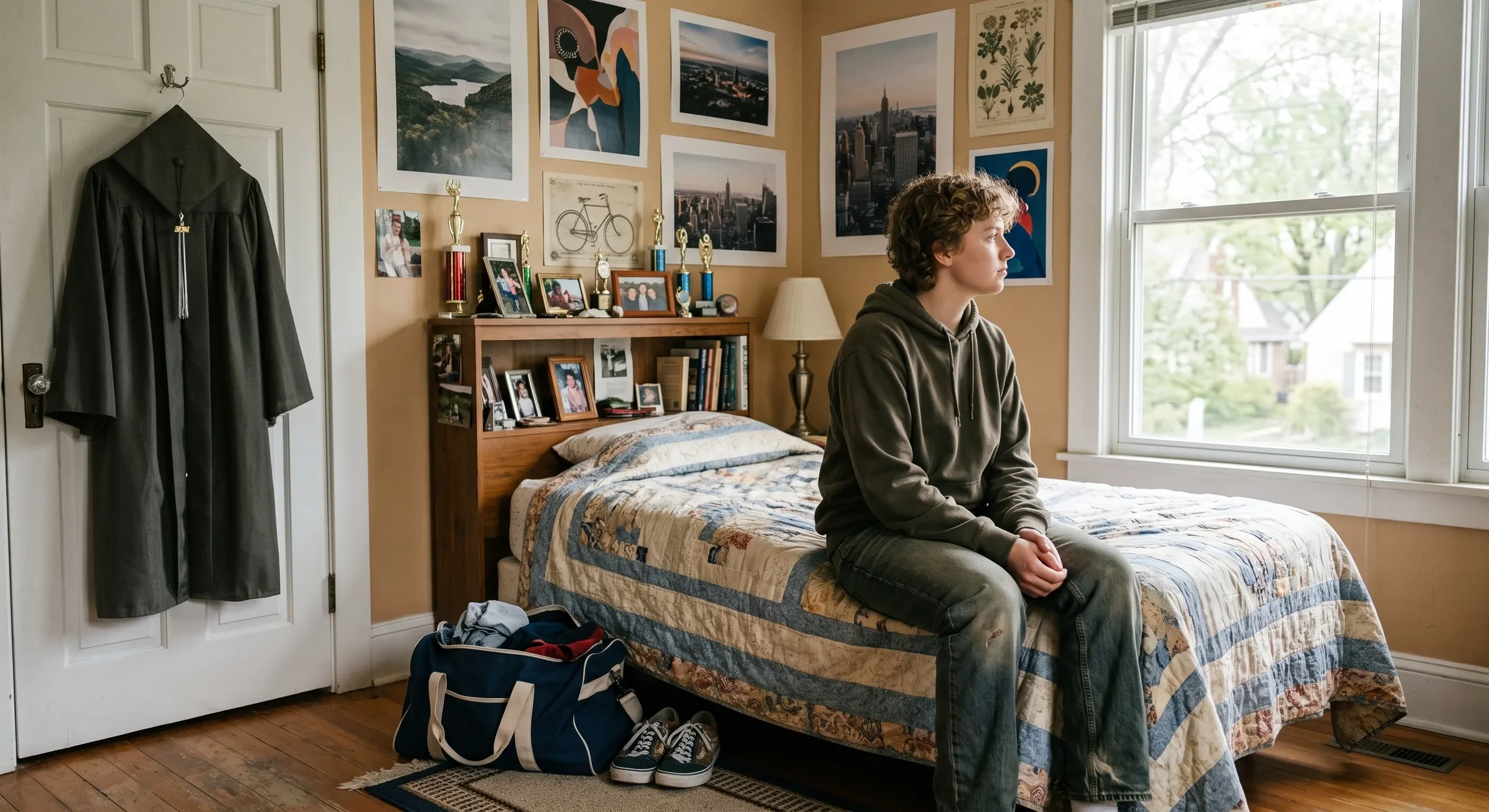
Moving back in with your parents after college is common, and for plenty of people it’s the only thing that makes financial sense. What tends to catch you off guard is everything else that comes with it. Nothing has obviously gone wrong, so when someone asks how you’re doing a few months in, you find you can’t answer honestly, because you don’t really know.
I’m Brooke Sundin, a Licensed Marriage and Family Therapist based in Los Angeles, and I work with teens and young adults online across California, Florida, Utah, and Tennessee. Many of the recent graduates I see have moved home, and what they describe is rarely one big problem.
I often hear that it feels like they have moved backward rather than simply entered a new stage of life. That feeling deserves to be taken seriously, and so does what sits underneath it: the loss of independence, the old family roles that come back, and an expectation that college ends with a job and a place of your own.
What Gets Hard After Moving Back In With Parents
Moving home can bring up a real loss of independence, especially for someone who spent four years setting their own schedule and making their own decisions. What I see more often than a single big problem is the return of old patterns. Coming home can bring back family roles and expectations that had faded while someone was away at school, and a young adult can find themselves responding the way they did at seventeen. Siblings tend to make that more noticeable, because it becomes easy to measure your own independence or progress against a brother or sister’s.
A 2023 study in PLOS ONE of more than 5,000 Australian young adults found that those living with parents scored about four points lower on a 100-point mental health scale than those living independently. The authors are careful to say they can’t tell which direction that runs, since the people already struggling may be the ones who need to move home. They also point to other research finding that depressive symptoms rise after young people move back in, even after accounting for the symptoms they already had.
When Everyone Knows You Moved Home
The expectation is that college ends with a job and a place of your own. It hasn’t moved much even as moving home has become common. Moving home puts you outside it, and that’s hard to keep private. Some people find out on their own, others have to be told, and for some young adults, having people know amplifies the shame or the sense of being judged. Often, the hardest part is not actually living at home but the story they begin telling themselves about what it means.
When a client tells me they’re embarrassed about it, I remind them that living at home after college doesn’t define their success, their independence, or where they’ll be five years from now. I encourage them to spend less attention on how their timeline compares to everyone else’s and more on what they are actually doing to build the life they want.
Why Nobody Can Tell You’re Struggling
When a young adult tells me they feel stuck, the daily version of that usually looks like sleeping late, staying home, avoiding friends, scrolling for hours, or struggling to get started on even small tasks. The harder part to put into words is the thinking underneath it. They’re constantly aware of what they should be doing, and genuinely unable to take the first step.
At a parent’s house, those signs are easier to miss. When someone lives on their own and starts struggling, it usually shows, because the dishes pile up and the laundry doesn’t get done. At home, meals still appear and the car is still in the driveway. A young adult can be technically functioning because their parents are helping with meals, laundry, transportation, or finances, while quietly becoming more withdrawn and more dependent.
What tells you more is whether anything has changed in your routines, your motivation, your social life, and how you’re eating and sleeping.
Is It Post Grad Depression, or a Rough Adjustment?
Post grad depression is the phrase people reach for to describe the low mood, anxiety, loneliness, and lack of direction that can follow graduation, even though it isn’t a clinical diagnosis. I use it with clients because it provides language for an experience that can otherwise feel very isolating.
Plenty of what looks like depression after graduation turns out to be something else. Anxiety, burnout, grief, perfectionism, and the ordinary difficulty of adjusting to a major life transition can all produce low mood and low motivation. I also see young adults become stuck because the pressure to make the “right” decision is high enough that they avoid making any decision at all, which reads as apathy from the outside and feels like paralysis from the inside. Losing the structure that organized the last four years does its own damage, which is why so much of what to do after college comes down to rebuilding it.
Depression has a threshold, and NIMH describes it as symptoms present “most of the day, nearly every day, for at least 2 weeks,” together with interference in day-to-day functioning. That threshold is harder to apply when you’re living at home, because it runs through functioning, and functioning is the part someone else is quietly holding up. Direction tells you more than any single day. Has your world been getting smaller, and is the pull toward staying in getting stronger rather than weaker? If it has already been small for a long time and nothing much moves in either direction anymore, that flatness counts too. A year of everything looking the same is not evidence that nothing is wrong.
Building Independence While Living With Parents as an Adult
Most advice about building independence assumes you have your own place. Independence is not all-or-nothing, and you can build it while living at home and while receiving financial or practical support from your parents. It might look like managing your own schedule, making your own decisions, contributing to the household, pursuing work, or taking responsibility for your own mental and emotional well-being.
Building any of that back usually starts with structure rather than with motivation. That order matters, because waiting to feel motivated first is how a lot of people spend a year. Getting out of the house, reconnecting socially, taking on responsibilities at home, pursuing work or hobbies, and setting personal goals are all small on their own. Over time, they rebuild confidence and momentum.
How Therapy Can Help
When a recent graduate living at home starts therapy with me, we usually begin by understanding what has changed since college and identifying where they feel most stuck, whether that is motivation, relationships, career uncertainty, family dynamics, or anxiety. From there we focus on small, realistic steps that help them regain a sense of structure, independence, and momentum.
With an adult client, I’m careful about involving parents, and I go by your age, your needs, and your consent rather than bringing them in by default. I’m also certified in SPACE, a parent-based program developed by Eli Lebowitz at the Yale Child Study Center. When parents are involved, I help them find ways to be supportive without taking over, so they can encourage your independence rather than unintentionally reinforcing avoidance or dependence.
Frequently Asked Questions
What is post-graduation syndrome?
Post-graduation syndrome is another informal name for the same experience as post grad depression, and neither term appears in any diagnostic manual. Both describe the low mood, anxiety, and loss of direction that can follow the end of school. The absence of a clinical label doesn’t make the experience less real or less worth addressing.
How long does post-grad depression last?
If what you’re experiencing is adjustment, it tends to ease as new structure and connection build, often over a few months. If it meets the threshold for depression, it doesn’t reliably resolve on its own with time. NIMH defines that threshold as symptoms present most of the day, nearly every day, for at least two weeks, with interference in daily functioning.
Why is post-grad life so hard?
Post-grad life is hard partly because several things that were handled for you end at once. Structure, a built-in social group, a clear role, and a sense of forward progress all came with being a student, and none of them are automatically replaced. For young adults who also move home, the loss of independence lands on top of all that, along with the daily experience of being back under a parent’s roof after four years of running your own life.
How can you get out of a post-grad depression?
Structure and purpose usually have to be rebuilt before motivation returns, rather than the other way around. If the standard advice about getting out and reconnecting with people is out of reach right now, that list is too big, and your real first step is smaller than anything on it. If you’ve experienced low mood for weeks, or your world has been narrowing rather than widening, working with a therapist tends to be more useful than waiting it out.
Getting Help After Moving Back Home
If you relate to anything in this post, it’s worth taking seriously rather than waiting out. In my work with young adults, we start by figuring out what’s changed since college and where you feel most stuck, and then we build from there in small, manageable steps.
If you’d like to talk about whether this is a fit, you can submit the contact form and we’ll find a time for a 15-minute consultation call.